The Lote Tree
The tree
The Lote Tree, botanically Ziziphus spina-christi and known across the Arabian Peninsula as the Sidr, is one of the oldest living symbols in human culture. It grows where little else will: in hard ground, in heat, in places that test what can survive. It gives shade to the tired, fruit to the hungry, and a home to the bee, whose Sidr honey is prized as one of the most potent on earth.
Why this tree
Loved Across All, Owned by None
The Lote Tree belongs to no single tradition. It is the same concept as the universal Tree of Life, recognised across the world under many names. Different traditions, different names, one tree.
| Tradition | The tree, by another name | Belief |
|---|---|---|
| Greek | Lotus | The honey-sweet fruit of Homer’s lotus-eaters in the Odyssey is the wild jujube of North Africa, whose sweetness was said to make travelers forget the way home. Herodotus wrote of the Lotophagi who lived on it. |
| African | Baobab | The upside-down tree, said to hold the wisdom of the ancestors in its hollow trunk. The Tree of Life from Senegal to Madagascar. |
| Ayurvedic | Badara | Its sister species in the same genus, the jujube or ber (Badara), is a classical tonic — sweet in taste, tridosha-balancing, used for sound sleep, steady digestion, and rebuilding strength. It is the humble fruit the devotee Shabari offered Lord Rama in the Ramayana. |
| Chinese | Da Zao | The red jujube date is one of the most-used herbs of all: it tonifies qi, nourishes the blood, and harmonizes every formula it enters, while the seed (Suan Zao Ren) calms the spirit and settles sleep. It has been recorded in the Chinese materia medica for some two thousand years. |
| Judaism | Etz Chaim | Etz chaim hi la-machazikim ba — she is a tree of life to those who hold fast to her. The wooden poles of the Torah scroll itself are called the Etzei Chaim. |
| Christianity | Spina-christi | Spina-christi means “Christ’s thorn”, by long tradition the crown of thorns was woven from its branches. Pilgrims to the Holy Land once carried cuttings home as relics. |
| Bahá’í | Sadratu’l-Muntahá | The Lote Tree at the boundary of the heavens, here the symbol of divine manifestation in every age. |
| Islam | Sidrat al-Muntaha | The Lote Tree of the Utmost Boundary named in Surah An-Najm: the tree at the edge of the seventh heaven, beyond which no creature may pass, reached by the Prophet on the Night Journey. |
Anatomy of the tree
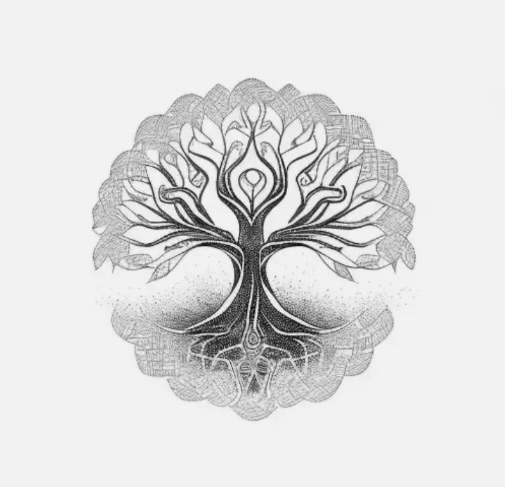
In Ayurveda and Chinese medicine, the jujube is working medicine: food that calms the spirit, tonifies, and rebuilds. What you eat and drink is the first medicine, and the foundation of Roots Cafe. Roots draw nourishment from the earth. Heartwood carries that nourishment and holds the whole tree together. The Canopy reaches into the light.
Women-led, by design
The Lote Tree is Women-led
It shapes the kind of room we are building. One defined by competence, care, and collaboration.